

Investors weighing Asia’s island markets face a trade-off between depth and growth. This article compares Phuket with Bali and Phu Quoc using official statistics where possible. The sources count visitors slightly differently and cover different periods, so each figure is labelled.Scale: Phuket and Bali are the established players
Bali recorded 6.95 million direct foreign arrivals in 2025, up 9.72%, according to Statistics Indonesia’s Bali office. Phuket received 4.16 million international tourists flying direct in the first ten months of 2025, up from 4.09 million a year earlier and 97.5% of its 2019 level. Phu Quoc is smaller, with about 1.8 million international arrivals in 2025.Phuket’s airport handled 17.34 million passengers in 2025, well above the roughly 12.5 million it was designed to handle. Access is its strength and now its constraint.Momentum: Phu Quoc is the growth story
In the first nine months of 2026, international arrivals to Phu Quoc rose 60.2% to more than 1.92 million, and the island expects 2.4 million for the year. New direct routes are driving it, including its first-ever direct flight from Russia in September.

The airport already handles about 40 international flights a day, and tourism revenue rose 47.7% to VND45.9 trillion over the same nine months. It is still a smaller base: that nine-month total is under half of Phuket’s ten-month figure for 2025.
Phuket and Bali are flat to slightly lower. Phuket’s foreign visitors were down 2.5% in January to August, and Bali’s were down 1.98% in January to July. Bali’s growth was a 2025 story, not a 2026 one.Visitor mix: broad, but not immune to concentration
Phuket’s top three markets in the same 10 months were Russia (832,976), India (488,387) and China (476,743), about 43% of arrivals by our calculation. Bali’s top three in 2025 were Australia (1.63 million), India (569,260) and China (537,380), about 39% by our calculation. Phuket’s base is broad, but it is not more diversified than Bali’s, and its reliance on Russia is notable. China’s recovery there remains incomplete, partly because direct flights from second-tier Chinese cities were significantly reduced, and Phuket had 998,228 Chinese visitors in 2024 against 3.12 million at the pre-pandemic peak.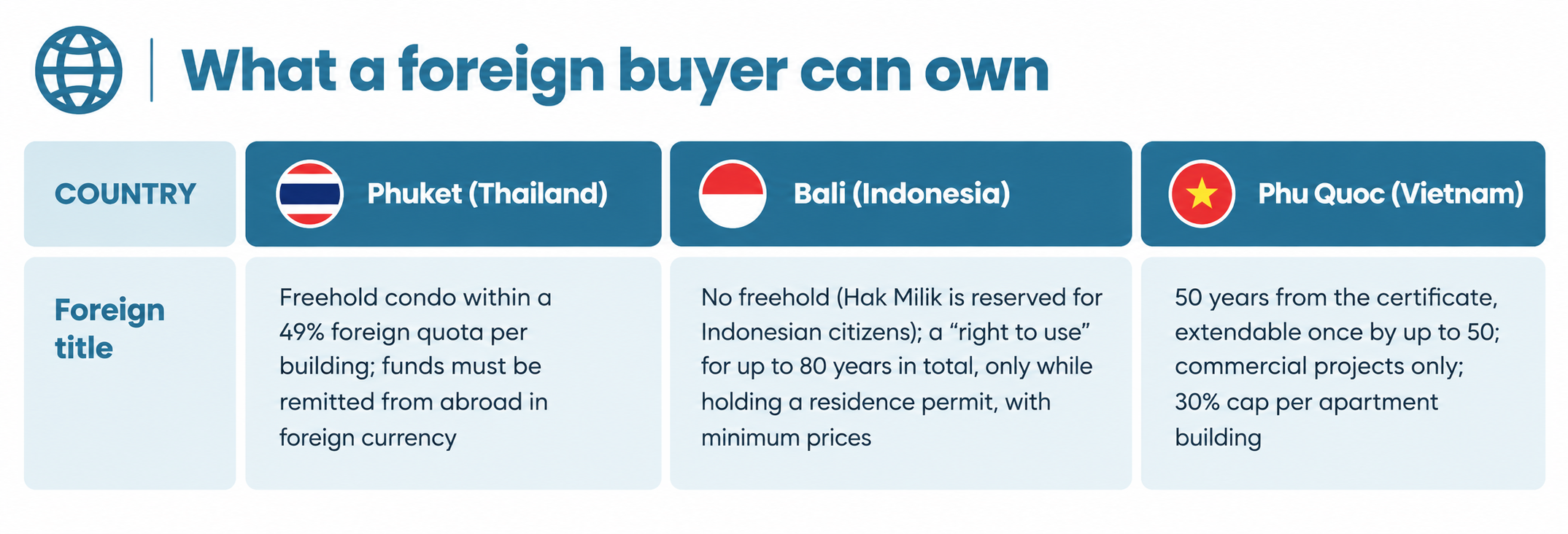
What the data cannot tell us
We found no reliable, comparable price or sales data for Bali and Phu Quoc property, so this article compares demand foundations, not returns. For Phuket, Knight Frank reports villa sales rose 12.9% in 2025 despite softer condo demand, and expects tougher competition among condo launches. Projects in secondary locations or without clear differentiation may see slower sales and longer sell-out periods.The takeaway
Phuket offers depth: a large international base, strong ownership terms, a track record of recovery and and Russian exposure. Its limits are slower growth, a congested airport. Phu Quoc offers rapid growth from a smaller base, and Bali sits between them: the largest of the three, but flat this year. The right choice depends on whether an investor values depth or growth. Whichever market is chosen, check the title terms, airport access and visitor mix before looking at the price.Sources:
Official statistics and government sources
BPS-Statistics Indonesia, Bali Province, Bali’s foreign arrivals January - December 2025
ANTARA News, Bali’s foreign tourist arrivals rise nearly 10 pct in 2025, BPS says
Vietnam News Agency via VietnamPlus, First direct flight from Russia brings more than 370 tourists to Phu Quoc
VnExpress International, Asia’s most favorite island expects to receive 2.4 million foreign tourists in 2026
VietnamPlus, Phu Quoc emerging as a favourite global destination
VnExpress International, Vietnam welcomes thousands of foreign tourists on first day of 2026
Viet Nam News, Is foreign ownership of real estate permitted in Việt Nam? (Housing Law 2023, April 2026)
Thailand tourism and airport
Bangkok Post, Phuket arrivals prove to be resilient
Khaosod English, Phuket arrivals dip as four new direct routes set to launch (TAT data, 29 September 2026)
TravelMole, Airports of Thailand strengthens its European market presence at ITB Berlin 2026 (AOT 2025 traffic)
Bangkok Post, AOT eyes Phuket airport upgrade
C9 Hotelworks, Phuket Hotel and Tourism Market Review, February 2025
Property and ownership rules
Bangkok Post, Phuket property set to stay strong in 2026 (Knight Frank)
LAFS Legal, Foreign Property Ownership in Thailand: What Changed in 2026
Ray White Indonesia, Everything foreigners need to know before buying property in Indonesia
ASEAN Briefing, Indonesia’s Omnibus Law: relaxed foreign ownership on real estate (GR 18/2021)
Others
